


1. LLM Guide
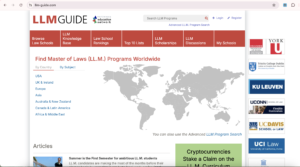
LLM Guide can easily be at the top of this list. It has a simple and user-friendly interface where you can comfortably research law master’s programs in almost every field. For each program, it shows the specific requirements, the academic background and history of the school, tuition fees, and other important details. It also provides information about scholarship opportunities offered to master’s students.
LLM Guide publishes a “Top 10 LL.M.” list every year, which can also be helpful during your research process. In my opinion, LLM Guide is one of the most comprehensive websites you can use while researching LL.M. programs.
2. Mastersportal
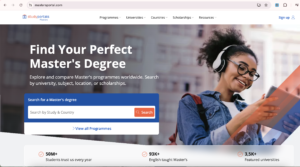
Mastersportal can be the second website you may benefit from. On this platform, you can also research master’s programs quite easily. You can select the country, field, and type of program you are interested in and compare different options one by one. You can also read my article about How Did I Decide Which LL.M. Program to Choose? here.
3. AI Tools
And of course, AI tools.
I started researching master’s programs three years ago, in 2023. Back then, these tools were not as widely available as they are today, so I was searching manually on Chrome. However, with the rise of AI, I also started using these tools ( especially ChatGPT ) during my research process. They especially helped me understand which master’s programs would be most compatible with the kind of life I imagined for myself in the future.
4. Consultations with Program Representatives
Another thing I strongly recommend is arranging consultations with the admissions or promotion teams of the master’s programs you are considering. When I was interested in a program, I would schedule meetings, prepare my questions in advance, and ask them directly to the people responsible for introducing the department. This gives you the chance to hear the information from a first-hand source.
5. Education Fairs and University Promotion Events
Sometimes, universities may visit your country to promote their master’s programs. If there are education fairs or university promotion events near you, I definitely recommend attending them. Meeting representatives face to face, collecting brochures and handbooks, and asking your questions directly can help you understand the school and the program much better.
6. LinkedIn Research
You should also search for the programs you are considering on LinkedIn and reach out to people who have studied there before. Yes, you should really do this,and you should not feel shy about it.
You can start with a polite message, explaining that you are considering applying to the program. Then you can ask whether they were satisfied with the department and the university, whether they would recommend the program, and if they do, what else they would suggest doing while studying there. You can also ask whether they know any other master’s programs that might be worth considering.
These people can become a guide for you. Also, by checking their LinkedIn profiles, you can see where they are currently working and what kind of career path they followed after graduation. This can be very useful when comparing different programs.
7. Taking Notes and Comparing Programs
This can sometimes be a difficult and long process, because I personally did a lot of research. In the end, the program that best matched the future life model I imagined for myself was the LL.M. Finance program offered by ILF.
I also researched this program in detail through the school’s official website. You can access the details through this link.
While researching the programs you are interested in, make sure to take notes on the admission requirements, internship opportunities, courses offered, academic backgrounds of the professors, language requirements, tuition fees, and scholarship options. When it is time to make a decision, these notes will become your guide.